Owning a historic home is a stewardship of history, a commitment to preserving the craftsmanship of a bygone era. However, when the very ground beneath that history begins to shift, the dream of preservation can quickly turn into a structural nightmare. Foundation failure in a landmark property isn’t just a maintenance issue; it is an existential threat to the building’s architectural integrity.
When cracks spider-web across hand-plastered walls or a heavy oak door suddenly refuses to latch, the clock starts ticking. Finding an emergency foundation repair contractor who understands the delicate chemistry of 19th-century masonry is the difference between saving a legacy and inadvertently accelerating its demise.
The High Stakes of Historic Stability
Foundation emergencies in historic homes—typically defined as those built before 1940—are fundamentally different from failures in modern suburban builds. Most modern homes sit on reinforced poured concrete. In contrast, historic footings often consist of stacked fieldstone, rubble trench, or soft-fired brick held together by lime-based mortar.
Why It’s an Emergency
A “foundation emergency” occurs when structural movement is active and accelerating. Signs include:
- Rapidly Expanding Cracks: Fissures in the foundation or exterior masonry that grow visibly wider over a few days.
- Wall Rotation: A foundation wall that is leaning or “bowing” inward, suggesting imminent hydrostatic collapse.
- Structural Disconnects: Joists pulling away from sill plates or chimneys separating from the main structure.
Unlike modern materials, historic masonry is “breathable” and flexible. When it finally snaps or shifts significantly, it often indicates that the underlying soil or the material’s structural limit has been reached. Delaying a response can lead to the “unzipping” of the home’s facade.
Immediate Triage: What to Do First
Before the heavy machinery arrives, the homeowner must act as the first responder.
- Monitor and Document: Place “crack monitors” or simple tape markers across active fissures. Note the date and width.
- Clear the Perimeter: Ensure gutters are directing water at least 10 feet away from the foundation. Hydrostatic pressure from saturated soil is the leading cause of emergency wall failure.
- Utility Check: If the house has shifted significantly, check gas and water lines for tension. A shifting foundation can shear a vintage pipe, leading to fire or flooding.
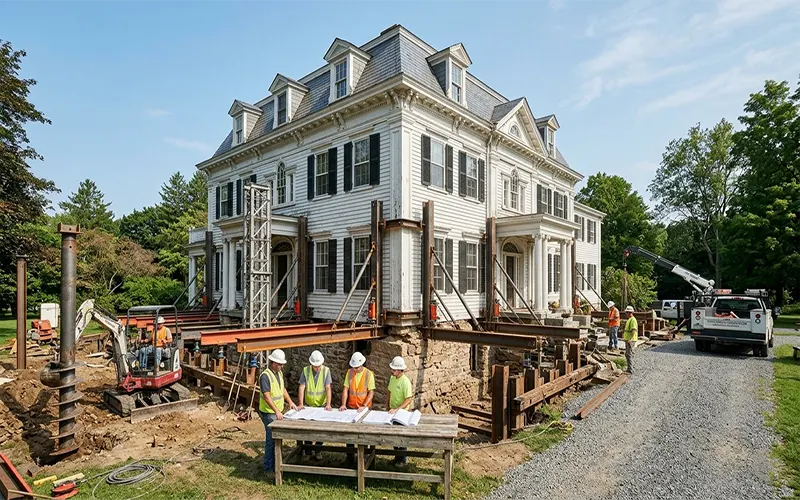
- Professional Shoring: In extreme cases, a contractor may need to install temporary shoring—heavy timber or steel posts—to take the load off the foundation while a permanent plan is engineered.
Qualities of an Elite Historic Foundation Contractor
The greatest risk to a historic home is often the contractor who treats it like a modern house. Modern foundation repair frequently involves high-pressure hydraulic lifting and high-PSI Portland cement. On a historic home, these “brute force” methods can shatter brittle bricks and cause catastrophic cracking in original plaster.
The Vetting Checklist
When interviewing emergency contractors, look for these specific credentials:
- Preservation Knowledge: They should understand the Secretary of the Interior’s Standards for Rehabilitation, specifically the mandate to repair rather than replace whenever possible.
- Material Compatibility: They must know why Portland cement should never be used to patch a lime-mortar foundation (it’s too hard and traps moisture, causing the stone to spall).
- Specialized Equipment: They should utilize low-pressure systems and hand-excavation techniques where necessary to protect the fragile perimeter.
Red Flags to Avoid:
- Contractors who suggest “leveling” the house to zero. Historic homes have settled over a century; forcing them back to “perfectly level” can cause more damage than the original shift.
- Companies that don’t ask for a structural engineer’s report.
- Bids that rely solely on “slab-jacking” with high-pressure foam for heavy stone footings.
Modern Methods for Ancient Footings
Fortunately, modern engineering offers several “low-impact” solutions that provide emergency stability without destroying the home’s soul.
1. Helical Piers
For homes suffering from soil subsidence, helical piers are often the gold standard. These are large steel screws that are bored deep into the earth until they hit load-bearing strata. They are then bracketed to the foundation. Because they are screwed in rather than hammered (like push piers), they create minimal vibration—crucial for protecting old glass and plaster.
2. High-Density Polyurethane Injection
In specific cases of “slab drop,” structural resins can be injected into the soil. However, for historic homes, this must be a closed-cell, low-expansion resin to avoid “lifting” the house too aggressively.
3. Underpinning with Lime-Compatible Grout
If the original stone foundation is crumbling, contractors may perform “pit underpinning.” This involves excavating small sections beneath the wall and pouring new footings. It is a slow, methodical process that ensures the house is never unsupported.
Navigating the Red Tape: Permits and Boards
One of the biggest hurdles in an emergency is the local Historic District Commission (HDC). In many jurisdictions, any structural work on a landmarked property requires a “Certificate of Appropriateness.”
A specialized historic contractor will know how to handle this. Most cities have “Emergency Provision” clauses that allow for immediate stabilization work to proceed before a formal hearing, provided the work doesn’t permanently alter the home’s appearance. An elite contractor will work directly with a structural engineer to provide the city with the necessary “Letter of Intent” to bypass standard 30-day waiting periods.
Cost vs. Long-Term Value
Emergency foundation repair is rarely cheap. Prices can range from $10,000 for minor stabilization to over $100,000 for full-scale underpinning and masonry restoration. However, in the world of historic real estate, the foundation is the “provenance” of the structure.
A modern, “cheap” fix—like slapping a concrete “skin” over a stone wall—will eventually fail, often taking the stone with it. Investing in a specialist ensures that the repair is invisible or sympathetic, maintaining the home’s resale value and historical status.
Preserving the Past for the Future
A foundation emergency is a frightening chapter in the life of a historic home, but it does not have to be the final one. These structures were built with a level of redundancy and quality of material rarely seen today. They are resilient, but they are also sensitive to the heavy-handedness of modern construction.
By choosing a contractor who views themselves as a preservationist first and a builder second, you ensure that your home remains standing for another century. When the ground moves, the right partner doesn’t just fix the dirt—they protect the heritage.