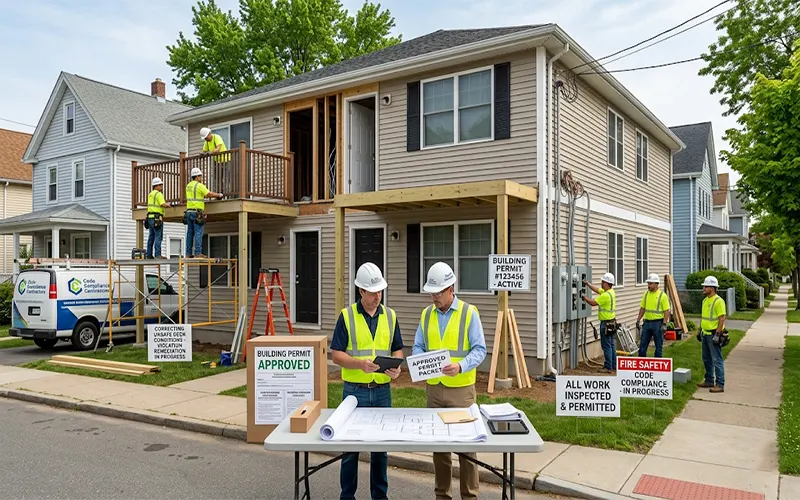
In the complex landscape of real estate investment and property ownership, few phrases strike more fear into a stakeholder’s heart than “Municipal Code Violation.” Whether it arrives as a “Stop Work Order” taped to a front door or a “Notice of Violation” found during a title search, a code issue is a significant legal and financial liability. It can halt a sale, trigger daily fines, and in extreme cases, lead to a “Vacate” order.
When a property is “red-tagged,” the path to resolution is rarely as simple as paying a fine. It requires a specialized category of professional: the Code Violation Correction and Permitting Contractor. These experts do not just build; they act as forensic investigators and municipal liaisons, working backward to bring unpermitted or non-compliant structures into the light of legal standing.
The “Red Tag” Crisis: Why the City Always Wins
A municipal code violation is more than a nuisance; it is a “cloud” on the property’s title. If a building has an outstanding violation, most traditional lenders will refuse to refinance the asset, and title companies will flag the property as having unmarketable title.
Furthermore, many municipalities operate on an escalating fine schedule. What begins as a $100 notice can balloon into thousands of dollars in liens if ignored. The specialized contractor acts as the bridge between the high-pressure environment of the Building Department and the property owner, providing a roadmap to “Strategic Compliance.”
Common Violations in the Modern Market
Violations typically fall into two categories: Safety Violations (structural, electrical, or fire hazards) and Zoning Violations (illegal use of space).
- Unpermitted Conversions: The most common “silent” violation involves turning garages, basements, or attics into living quarters without the required egress or insulation.
- Structural Failures: Decks built without proper footings or load-bearing walls removed during a “DIY” open-concept renovation.
- Zoning Inconsistencies: In regions like Malang, this often manifests as building beyond the allowed “setback” lines or failing to secure the PBG (Persetujuan Bangunan Gedung)—the Indonesian building permit—before starting construction.
There is a persistent myth that if a violation is old enough, it is “grandfathered in.” In reality, building codes are retroactive when it comes to life-safety issues. The city does not forget; it simply hasn’t checked yet.
The Anatomy of a Correction Project: Forensic Construction
Hiring a standard “remodeling” contractor to fix a violation is a common mistake. A Code Correction Contractor must perform “Forensic Construction”—the art of working backward.
1. The Forensic Inspection
The contractor must determine what is behind the finished walls. This often involves using thermal imaging, moisture meters, and borescope cameras to inspect wiring, plumbing, and framing without demolishing the entire room.
2. As-Built Drawings
Before the city will issue a retroactive permit, they need to see what currently exists. The contractor coordinates with architects and engineers to create “As-Built” drawings. These blueprints document the current state of the building and identify exactly where it deviates from the local code.
3. Selective Demolition
To satisfy a building inspector, the contractor often has to perform “Selective Demolition.” This means opening up “viewing holes” in the drywall at specific intervals so the inspector can verify that the electrical wiring is grounded and the plumbing is properly vented.
The Retroactive Permitting Process
Correcting a violation usually requires a Permit to Authorize previously completed work. This process is often more scrutinized than a standard new-build permit.
- The “Double Fee” Penalty: Many municipalities charge a “Work Without Permit” penalty, which can double or triple the standard filing fees as a punitive measure.
- The Administrative Burden: A significant portion of a correction contractor’s fee goes toward the “Paperwork War”—attending hearings, filing tax-related property compliance through systems like Coretax, and securing the SLF (Sertifikat Laik Fungsi) to prove the building is fit for occupancy.
WARNING: The “Under-the-Table” Trap
Be wary of contractors who promise to “make a violation go away” without involving the city. Fixing a code issue without a permit is simply creating a second violation on top of the first. If a contractor suggests bypassing the building department, they are a liability, not a solution.
Zoning vs. Building Code: Navigating the Board
Sometimes, a project is built perfectly to code but violates Zoning Laws. This might mean the building is too tall, too close to the neighbor’s fence, or has too many units for the neighborhood.
In these cases, a correction contractor works alongside a land-use attorney to petition the Zoning Board of Appeals (ZBA) for a “Variance.” This is a legal exception to the rule. The contractor’s role is to provide the technical evidence that the variance is necessary and that the structure remains safe for the community.
The Financial Impact: From Liability to Asset
Investors often balk at the cost of code correction, which can be 20% to 30% higher than standard construction due to the administrative and forensic requirements. However, the ROI is substantial.
- Marketable Title: Clearing a violation allows for a clean sale, often at a much higher price point because the “risk” has been removed for the buyer.
- Refinancing Power: Only with a “Certificate of Compliance” can an investor pull equity out of a property to fund the next acquisition.
- Risk Mitigation: Correcting a structural or electrical violation protects the owner from catastrophic insurance claims. If a fire occurs in an unpermitted kitchen, the insurance company has legal grounds to deny the claim entirely.
Code Correction Workflow: The Path to Compliance
- Discovery: Receive the violation notice and identify the specific code sections cited.
- Consultation: Hire a contractor to perform a site-audit and forensic review.
- Design: Architect creates “As-Built” drawings for municipal submission.
- Submission: File for retroactive permits and pay associated penalties.
- Execution: Perform the physical “Correction” work (Selective Demolition and Repair).
- Inspection: Host the building inspector for the final walkthrough.
- Closure: Secure the final sign-off and ensure the violation is removed from the public record.
Partnering for Protection
Real estate is an asset class built on the foundation of law and safety. A code violation is a fracture in that foundation. By hiring a professional Code Violation Correction and Permitting Contractor, you are not just “fixing a house”; you are performing a legal “cure” on your investment.
Whether you are navigating the complex PBG requirements in Malang or resolving a red-tag in a major metropolitan center, the goal remains the same: transforming a high-risk liability back into a high-value asset. In the world of real estate, compliance is the only true path to long-term profitability.