For the vast majority of seniors, the word “home” represents more than just real estate; it is a repository of memories, a sense of community, and a bastion of independence. Statistics consistently show that nearly 90% of adults over the age of 65 prefer to stay in their current homes as they age. This concept, known as “Aging-in-Place,” is a powerful movement toward maintaining home continuity.
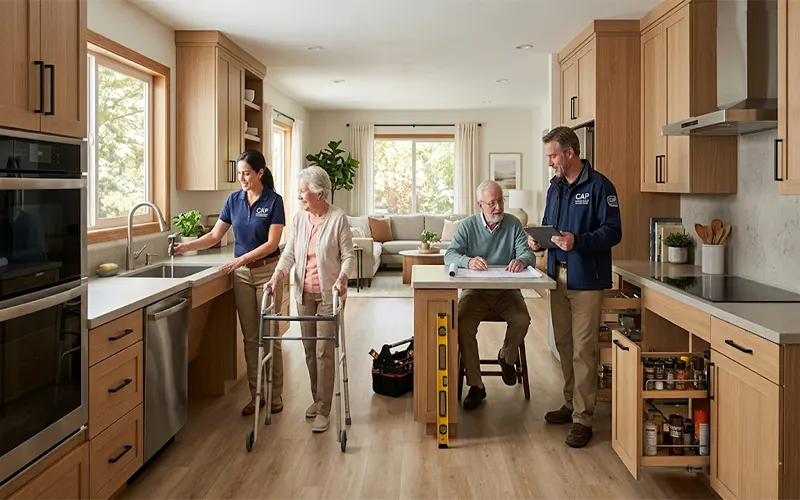
However, the standard residential kitchen—with its high reach-in cabinets, heavy appliances, and slippery floors—is often the most hazardous room for someone with changing mobility or sensory needs. This is where Certified Aging-in-Place Specialist (CAPS) contractors become essential. These professionals are trained by the National Association of Home Builders (NAHB) to understand the unique needs of the aging population, ensuring that a kitchen renovation is not just a cosmetic upgrade, but a strategic investment in lifelong independence.
The Philosophy of Aging-in-Place
A CAPS-certified contractor differs from a standard remodeler because they look at a home through the lens of Universal Design. Universal Design is the practice of creating environments that are usable by all people, regardless of age, size, or ability, without the need for adaptation or specialized design.
When you hire a certified specialist, you aren’t just getting a builder; you are getting a consultant who understands the progression of mobility challenges, the ergonomics of arthritis, and the importance of visual contrast for declining eyesight. The goal is to create a “Forever Kitchen” that looks like a high-end luxury space but functions with clinical precision.
The Ergonomics of Independence: Layouts and Flow
The traditional “Work Triangle” (the path between the stove, sink, and refrigerator) often fails seniors who use mobility aids. CAPS contractors prioritize a “Work Station” or “Zone” approach.
- The 5-Foot Radius: In an aging-in-place kitchen, the floor plan must accommodate a five-foot turning radius to allow for easy maneuvering of a wheelchair or walker.
- Wider Thoroughfares: Doorways and pathways are expanded to at least 36 inches. This prevents the “bottleneck” effect that can lead to bumps and falls.
- Seated Workspaces: A hallmark of the accessible kitchen is the inclusion of a “knee-space” opening under the countertop, allowing a user to prep meals or wash dishes comfortably from a seated position.
Cabinetry and Storage: Bringing the Kitchen to the User
One of the greatest challenges for seniors is the physical act of reaching—either high up into wall cabinets or deep into base cabinets. Professional aging-in-place contractors solve this by making the kitchen “come to the user.”
- The End of Base Cabinets: Standard base cabinets are replaced with deep, full-extension drawers. Instead of kneeling to find a pot in the back of a dark cabinet, the user simply pulls the drawer out into the light.
- Motorized Solutions: For upper cabinetry, CAPS contractors can install motorized shelving units that lower the contents of the cabinet down to the counter level at the touch of a button.
- Hardware for Dexterity: Knobs are replaced with D-shaped pulls. These allow users with arthritis or limited grip strength to open drawers using a closed fist or a single finger.
Safety and Vision: Lighting and Flooring
As we age, our “visual acuity” declines, and our sensitivity to glare increases. A poorly lit kitchen is a primary contributor to falls and knife-related injuries.
Layered Lighting
A certified contractor will implement a layered lighting plan:
- Task Lighting: Intense LED strips under cabinets to illuminate cutting surfaces without creating shadows.
- Toe-Kick Lighting: Low-level lighting at the base of cabinets that serves as a permanent nightlight, ensuring the path is visible during late-night visits to the kitchen.
- High-Contrast Finishes: Using contrasting colors between the countertop and the floor helps those with depth-perception issues distinguish where surfaces end and paths begin.
Slip-Resistant Flooring
Flooring in an aging-in-place kitchen must strike a balance between slip resistance and “wheel-ability.” Matte-finish luxury vinyl plank (LVP) or textured slip-resistant tile are preferred. These materials provide the necessary “grip” for feet while allowing walkers and wheelchairs to glide without catching on thick grout lines or plush rugs.
Appliance Selection for the Modern Senior
The right appliances can significantly reduce the risk of fire and burns, which are major concerns for seniors living alone.
- Induction Cooktops: These are a “Safety First” favorite. Because they use magnetic fields to heat the cookware directly, the surface stays cool to the touch, virtually eliminating the risk of accidental burns.
- Wall Ovens: Installing an oven at “comfort height” (eye level) removes the need for the user to bend over a hot, heavy door.
- French Door Refrigerators: These allow for a wider access point and keep frequently used items at eye level, reducing the need for crouching.
Safety First Sidebar
- Anti-Scald Devices: Contractors can install mixing valves in the plumbing to ensure water never reaches a temperature that could cause third-degree burns.
- Auto-Shutoff: Modern “smart” stoves can be equipped with sensors that automatically cut power if they are left unattended for too long.
- Fire Suppression: Specialized stove-top fire canisters can be tucked under the range hood for automatic activation.
The Vetting Process: Hiring the Right Partner
When looking for a contractor, “CAPS” should be the first acronym you look for.
- Verify the Credential: Ask to see their certification from the NAHB.
- Request a Life-Stage Assessment: A great contractor won’t just ask about your cabinet color; they will ask about your current mobility and your 10-year outlook.
- Check for “Universal” Portfolios: Look at their past work. Does it look like a hospital, or does it look like a beautiful, functional home? The best contractors hide the “safety” inside the “style.”
Investing in Your Future Self
Remodeling a kitchen for aging-in-place is often viewed as a daunting task, but when compared to the monthly cost of an assisted living facility—which can range from $4,000 to $8,000 per month—a $30,000–$50,000 renovation pays for itself in less than a year.
More importantly, it is an investment in your “Future Self.” By partnering with a Certified Aging-in-Place contractor, you are ensuring that your kitchen remains the heart of your home, regardless of what the future holds. It is a commitment to living life on your own terms, in the place you love most.