In the realm of home performance, windows are often described as “controlled holes” in the building envelope. In temperate regions, a window’s inefficiency is a minor nuisance; however, in cold climates—where temperatures routinely plunge below zero—windows become the primary “holes in the thermal bucket.” Standard windows can account for up to 30% of a home’s total heating energy loss.
For homeowners in northern latitudes, energy-efficient window replacement is not merely an aesthetic upgrade; it is a critical intervention in building science. Modern high-performance fenestration (the design of a building’s openings) utilizes advanced glazing, inert gas fills, and sophisticated framing to create a thermal barrier that keeps the furnace’s hard-earned heat exactly where it belongs: inside.
The Anatomy of a Cold-Climate Window
To understand why a specialized cold-climate window is superior, one must look at the science of the “Insolated Glass Unit” (IGU).
Triple Glazing: The Gold Standard
In extreme cold, the “R-value” (resistance to heat flow) of a window is the priority. While double-pane windows were the standard for decades, triple glazing is now the recommended baseline for cold climates. By adding a third pane of glass, the window creates two distinct insulating chambers. This significantly reduces “cold radiation”—that chilly sensation you feel when standing near a window in winter, even if there is no air leak.
The Role of Argon and Krypton Gas
The spaces between these glass panes are not filled with air, which contains moisture and conducts heat. Instead, they are filled with dense, inert gases.
- Argon: The most common choice; it is denser than air and significantly slows down the convection currents between the panes.
- Krypton: More expensive but even denser than Argon. It is often used in triple-pane units where the spaces between panes are thinner, providing elite-level thermal resistance.
Low-E Coatings and Surface Orientation
Low-Emissivity (Low-E) coatings are microscopically thin metallic layers applied to the glass. In cold climates, the goal is to reflect heat back into the room. Building scientists often recommend a “high solar gain” Low-E coating on south-facing windows. This allows the sun’s short-wave radiation to enter and warm the home (passive solar heating) while the Low-E coating prevents that heat from escaping.
Frame Science: Beyond Aesthetics
The frame is the skeleton of the window, and in cold climates, its material can be the difference between a warm room and a frosted sill.
- Fiberglass: Widely considered the premier choice for cold climates. Fiberglass has a thermal expansion rate almost identical to glass, meaning the seals are less likely to fail during extreme temperature swings. It is also a natural insulator.
- Insulated Vinyl: A cost-effective option. High-quality vinyl frames for cold climates are often “multi-chambered” and injected with polyurethane foam to prevent thermal bridging.
- Wood-Clad: Wood offers the best natural insulation, but it requires maintenance. Cladding the exterior in aluminum or vinyl protects the wood from ice and snow while keeping the interior warm.
Condensation Warning: Why Frost Forms
Interior frost or heavy condensation on old windows occurs when the interior surface of the glass falls below the dew point of the indoor air. This is a sign of “thermal bridging.” High-performance windows with warm-edge spacers (non-metallic spacers between panes) keep the edges of the glass warmer, preventing ice buildup and mold-inducing moisture.
Understanding the Metrics: The “Tech Spec” Section
When reviewing quotes from window replacement services, homeowners should ignore the marketing fluff and focus on three key NFRC (National Fenestration Rating Council) ratings:
- U-Factor: This measures the rate of heat loss. In cold climates, you want the lowest number possible. Look for a U-Factor of 0.27 or lower (some elite triple-pane units reach 0.15).
- SHGC (Solar Heat Gain Coefficient): This measures how much sun heat comes through. In the North, an SHGC of 0.30 to 0.60 on south-facing windows can actually help lower your heating bill via the greenhouse effect.
- Air Leakage (AL): This measures how much air “leaks” through the window’s joins. A rating of 0.3 or less is essential to stop winter drafts.
The Critical Importance of Specialized Installation
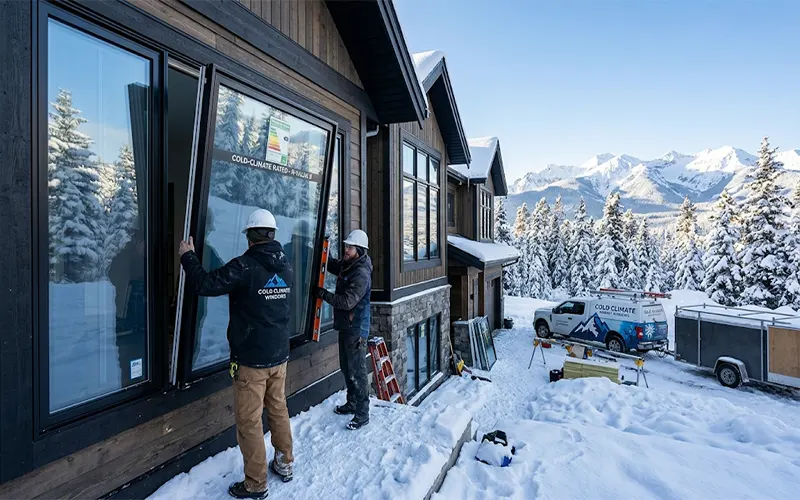
Even the most expensive triple-pane window will fail if installed poorly. In cold climates, the “Full-Frame Replacement” is vastly superior to the “Insert (Pocket) Replacement.”
Full-Frame vs. Insert
An Insert Replacement simply slides a new window into the old frame. This is faster but ignores the potential rot or lack of insulation in the original rough opening.
A Full-Frame Replacement removes everything down to the structural studs. This allows the installers to:
- Inspect for water damage or rot.
- Apply modern flashing tapes to prevent wind-driven snow from entering the wall.
- Use closed-cell expanding foam to seal the gap between the window and the house, creating a continuous airtight seal that “pocket” installs often miss.
ROI: Why the Investment Makes Sense
While cold-climate window replacement has a higher upfront cost, the Return on Investment is realized in three ways:
- Immediate Energy Savings: Homeowners typically see a 15–30% reduction in peak winter heating costs.
- HVAC Longevity: By reducing the “load” on your furnace, your heating system doesn’t have to cycle as often, extending its lifespan.
- Government Incentives: In 2026, many federal and local programs offer significant tax credits for “Energy Star Most Efficient” certified windows, often offsetting thousands of dollars in project costs.
Winter-Proofing Your Legacy
Replacing windows in a cold climate is an exercise in building longevity. By moving to triple-glazing, choosing frames with low thermal conductivity, and insisting on full-frame installation, you are doing more than just lowering a bill. You are eliminating the “cold zones” in your home, protecting your structure from moisture damage, and ensuring that even on the most brutal January nights, your living space remains a sanctuary of warmth.