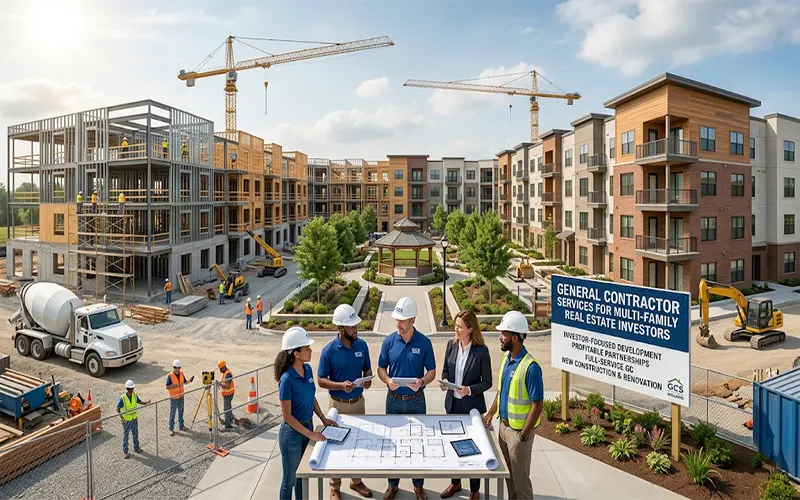
In the world of multi-family real estate, the relationship between an investor and a general contractor (GC) is the fulcrum upon which the entire investment’s success balances. Unlike single-family residential flips, where emotion and “curb appeal” often drive decisions, multi-family construction is a game of cold, hard metrics: Net Operating Income (NOI), Cap Rates, and Depreciation Schedules.
For the “Value-Add” investor—those moving an asset from Class C to Class B—a general contractor is not just a builder; they are a strategic partner in asset appreciation. The goal of multi-family contractor services is to execute a renovation that justifies a rent premium while simultaneously reducing future maintenance liabilities.
The Multi-Family Lifecycle: The Value-Add Strategy
The role of a professional GC begins long before the first hammer swings. In the acquisition phase, a GC provides the “Feasibility Study”—an honest assessment of the CapEx (Capital Expenditure) required to bring a neglected building up to market standards.
When an investor buys a 50-unit complex with “deferred maintenance,” they are essentially buying a problem that the GC must solve. A professional service provider identifies which renovations will lead to the highest rent bumps and which are necessary to prevent the “invisible killers” of profit, such as systemic plumbing failures or inefficient HVAC units.
Scalability and Uniformity: The “Package” Approach
The most significant service a multi-family GC provides is the creation of a Unit Turn Package. In a 100-unit building, you cannot treat each apartment as a bespoke project.
Why Uniformity Matters
A specialized multi-family GC will help the investor select a standardized set of finishes:
- Uniform Paint Colors: Usually a high-durability “eggshell” finish in a single neutral tone across all units.
- Standardized Hardware: Matching faucets, door handles, and light fixtures.
- Bulk Flooring: LVP (Luxury Vinyl Plank) purchased by the pallet.
By standardizing the units, the investor simplifies future maintenance. If a tenant in Unit 12 breaks a cabinet door, the on-site maintenance team already has the exact replacement in the shop because every unit in the portfolio uses the same SKU. This “systems over sentiment” approach is what allows an investor to scale from 10 units to 500.
Logistics of the “Occupied Reno”
One of the most complex services offered by multi-family GCs is the Occupied Renovation. For many investors, it is financially impossible to vacate an entire building for a year.
A specialized GC manages a “rolling turn.” This involves:
- Tactical Strikes: Renovating a single unit in a 5-to-7-day window the moment a tenant moves out, minimizing the vacancy loss.
- Resident Management: Coordinating with the property manager to ensure that exterior or common area work (like roofing or hallway painting) causes minimal disruption to the existing rent-paying tenant base.
- Safety Protocols: Implementing strict “clean-site” policies to ensure that construction debris and noise do not lead to a mass exodus of current residents.
Common Area & Exterior “Force Multipliers”
While unit interiors justify individual rent increases, the Common Areas drive the overall building valuation. A general contractor provides “Force Multiplier” services that increase the “Perceived Class” of the asset.
- Exterior Resurfacing: Modernizing a dated 1980s brick exterior with siding, high-contrast paint, or modern architectural panels.
- Amenity Construction: Converting a basement storage area into a fitness center or a co-working space.
- Signage and Lighting: Professional signage and LED perimeter lighting don’t just look good; they increase the security profile of the building, making it more attractive to high-quality tenants.
The “Big Three” Multi-Family Systems
A multi-family GC must address the “Invisible Killers” of NOI. If a unit is beautiful but the plumbing fails twice a month, the maintenance costs will eat the rent premium.
- Plumbing Overhauls: Replacing galvanized pipes or polybutylene with PEX throughout the entire building.
- Electrical Upgrades: Upgrading old “Zinsco” or “Federal Pacific” panels which are insurance liabilities.
- HVAC Synchronization: Moving from inefficient window units to centralized mini-split systems. In tropical regions like Malang, choosing monsoon-resistant exterior coatings and high-efficiency cooling is critical for long-term durability.
Project Management Tech Sidebar
Modern multi-family GCs use sophisticated software like Procore or Buildertrend. For the investor, this means:
- Daily Logs: Seeing photos of progress without visiting the site.
- Budget Transparency: Real-time tracking of the CapEx budget.
- Centralized Communication: All change orders and permit documents are stored in a single cloud-based repository.
Compliance, ADA, and Fire Safety
Multi-unit dwellings are subject to significantly stricter codes than single-family homes. A professional GC acts as the liaison between the investor and the Fire Marshal.
- ADA Compliance: Ensuring that a percentage of units and all common areas meet Americans with Disabilities Act standards (or local equivalents).
- Fire Suppression: Managing the installation of sprinklers, fire-rated doors, and interconnected alarm systems.
- Egress Requirements: Ensuring all units have the required safety exits to pass a municipal inspection.
Financial Management: Draw Schedules and Insurance
A multi-family GC understands that the investor is often beholden to a Commercial Lender. This requires a specialized financial workflow:
- Draw Schedules: The GC provides the documentation (lien waivers and invoices) required for the bank to release the next “draw” of construction funds.
- Performance Bonds: For large-scale projects, the GC provides a bond that guarantees the work will be completed, protecting the investor’s capital.
- Liability Coverage: Specialized GCs carry high-limit liability insurance that specifically covers multi-unit residential construction, protecting the investor from lawsuits involving tenant injury during the build.
Partnering for Cap Rate Compression
In multi-family real estate, every $1 saved in annual operating expenses or $1 gained in annual rent increases has a 10x to 15x impact on the property’s valuation (depending on the market’s Cap Rate).
Hiring a general contractor who specializes in the multi-family sector is not just about “getting the work done.” it is about executing a repeatable, scalable system that turns an underperforming asset into a “Core Plus” property. By focusing on uniformity, speed, and systemic reliability, the GC helps the investor move from managing a building to managing a high-yield financial instrument.